Home | Veterans | Guy Eddy
GuyEddy

A veteran interview with

Guy Eddy

Play video
Watch the interview

About Guy Eddy

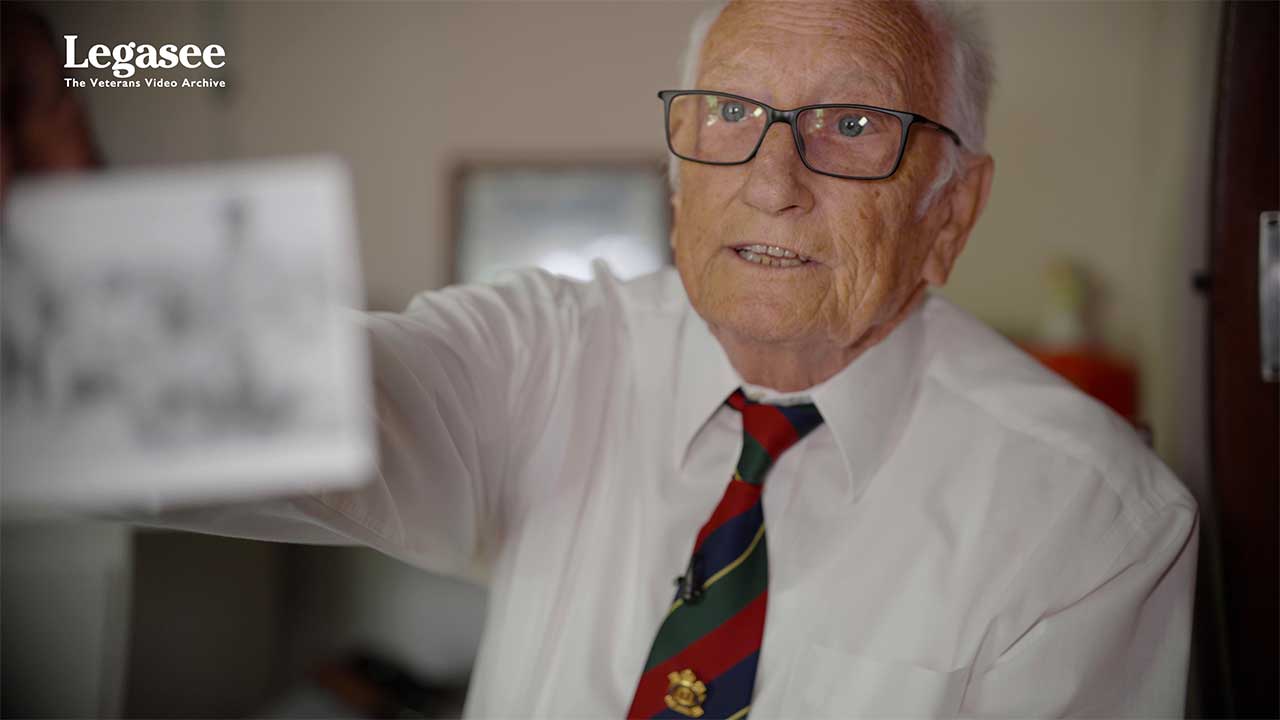
Cornish boy to a Berlin Airlift veteran, Guy Eddy provides an outstanding account of his time in the Royal Air Force. Born in the Cornish countryside to a farming family and leaving school at 16 and a half , he was unsure of what his career would entail at the beginning of the Second World War. Humble beginnings as an RAF Admin Apprentice, Guy knew he wanted to join the force and be a part of the fight to freedom. After 18 months of training in London, he began travelling around the world from India, South Africa and Southern Rhodesia to develop his piloting skill in a variety of vehicles. Guy recalls ‘getting his wings’ in 1944 and after that, his career in the force excelled with magnificent force. He reflects on his time in the war and the countries his squadron helped. Guy provides an insight into the items traded on the Black Market with one amusing story where some South Africans wanted to trade coffee beans for something more lucrative. Guy reflects on his time as a pilot during the Berlin Airlift with the unusual packages he delivered and believes it was worthwhile job for him. His account highlights the beautiful and tragic events he witnessed as a pilot in the RAF, finishing with his time flying Britannia’s. He finds himself transporting radioactive fuel rods from Singapore to Tokyo for the building of Japanese nuclear power stations. It was highly secretive work and also highly likely that Fukishima was one of the recipients. Overall, Guy Eddy had a remarkable career befitting a remarkable man.

Credits

Interviewed by:
Martin Bisiker
Reviewed by:
Hannah Bowers

Transcripts:
Please note that transcripts and closed captions in the video player are automatically generated by Vimeo.

Copyright:
All video content, web site design, graphics, images (including submitted content), text, the selection and arrangement thereof, underlying source code, software and all other material on this Web site are the copyright of Legasee Educational Trust, and its affiliates, or their content and technology providers. ALL RIGHTS RESERVED. Any use of materials on this Web site – including reproduction for purposes other than those noted above, modification, distribution, or republication – without the prior written permission of Legasee Educational Trust is strictly prohibited.

Home | Veterans | Guy Eddy

A veteran interview with

Guy Eddy

GuyEddy

Related topics & talking points

Keep on watching

More veteran stories...

Share this interview on:

https://www.legasee.org.uk/veteran/guy-eddy/

Cite this interview:

MLA Style:
Eddy, Guy. A Veteran Interview with Guy Eddy. Interview by Martin Bisiker. Legasee, 26 May. 2013 https://www.legasee.org.uk/veteran/guy-eddy/. Accessed 17 Nov. 2025.
APA Style:
Eddy, G. (2013, May 26). A Veteran Interview with Guy Eddy [Interview by Martin Bisiker]. Legasee. Retrieved November 17, 2025, from https://www.legasee.org.uk/veteran/guy-eddy/
Chicago Style:
Eddy, Guy. 2013. A Veteran Interview with Guy Eddy. Interview by Martin Bisiker. Legasee, May 26. Accessed November 17, 2025. https://www.legasee.org.uk/veteran/guy-eddy/
Harvard Style:
Eddy, G. (2013). A Veteran Interview with Guy Eddy. [Interviewed by Martin Bisiker]. Legasee, 26 May. Available at https://www.legasee.org.uk/veteran/guy-eddy/ (Accessed: 17 November 2025)
Vancouver Style:
Eddy, G. A Veteran Interview with Guy Eddy [Internet]. Interview by M. Bisiker. Legasee; 2013 May 26 [cited 2025 Nov 17]. Available from: https://www.legasee.org.uk/veteran/guy-eddy/
An interview with

Alec Chambers

Flight Engineer Alec Chambers: Pioneering Air Refueling in the Berlin Airlift

Alec Chambers served as a Flight Engineer during the Berlin Airlift with Flight Refueling Limited, becoming involved through Sir Alan Cobham, who provided tanker services for refueling aircraft over Berlin. Before the airlift, he participated in North Atlantic trials using modified Lancaster bombers for refueling missions. Chambers operated specialized equipment such as sinker weights and line-throwing guns to ensure safe fuel transfer between tankers and receiving aircraft, managing hydraulic systems and securing lines during operations. Originally from Shrivenham, Berkshire, Chambers volunteered for aircrew in World War II but initially served as an Engine Fitter. He was called up in January 1944 and trained as a Flight Engineer. After the war, he continued in-flight refueling with Cobham's organization, which transitioned to Tarrant Rushton to support the Berlin Airlift. While stationed in Wunstorf near Hannover, he described the chaotic post-war environment and his routine of checking aircraft readiness and coordinating refueling operations. Chambers noted the challenges of flying Lancasters with heavy fuel loads, adapting them for airlift despite their bombing design, and shared experiences of turbulence and landing difficulties due to shifting fuel weight. His account highlights the logistical challenges of air refueling during this critical period in history. 
Service:
Interviewed by:
Martin Bisiker
An interview with

John Whitlock

Since an early age John always wanted to fly and during the Airlift flew 356 trips to Berlin, once flying with a drunken pilot.

John wanted to fly since the age of ten, when, on the top deck of an open trolley bus he saw a Rapide biplane land at Croydon aerodrome. He joined the RAF during WW2 and later served as a signals engineer on the Avro York. Unknown to the crew his aircraft was used as a ‘guinea pig’ test of GCA (Ground Controlled Approach). GCA was a procedure where ground control guides the aircraft in during bad visibility and was widely used during the Berlin Airlift. This enabled aircraft to land every two to three minutes, even during the severe winter weather. During the Airlift John flew 356 trips and only one of these was aborted. One time he flew with a pilot who was so drunk that he was unable to carry out the pre-flight visual inspection but flew correctly once they were airborne. After a crash at Wunstorf which killed the crew, John served as one of the pallbearers at the funeral. He was in his early twenties and never thought about dying, believing that fate played a large part in matters of life and death. On the 60th anniversary of the Airlift the Berlin Airlift Association went to Templehof airfield in Berlin for a memorial service. Here he was thanked by the elderly and the very young, an experience he found moving. At the time of the Airlift he thought he was only doing his duty but later he became aware of its importance of it to Berliners.
An interview with

Stan Hope

Stan Hope was captured in 1942 and, despite attempts to escape, was not liberated until May 1945

Stan joined the RAF in July 1940 and was assigned to a reconnaissance unit and returning from a mission his aircraft had engine failure, and he baled out over occupied Belgium. After walking for two days he was able to board a train to Brussels where his ability to speak French helped him. Here he met the Resistance who used the Comète Line to smuggle him to a village near the Spanish border. Here his group was discovered by German troops. Despite being in civilian clothes with false papers he, and his comrades, avoided being shot. They were interrogated quite roughly and he spent four months in solitary confinement. Eventually he was taken to a Gestapo prison and later to a POW camp where he faced further interrogation. Near the end of the war he and his comrades were moved to several different camps before eventually being freed in May 1945.
Service:
Interviewed by:
Martyn Cox