Home | Veterans | Gordon Mellor
Goirdon-Mellor-Still

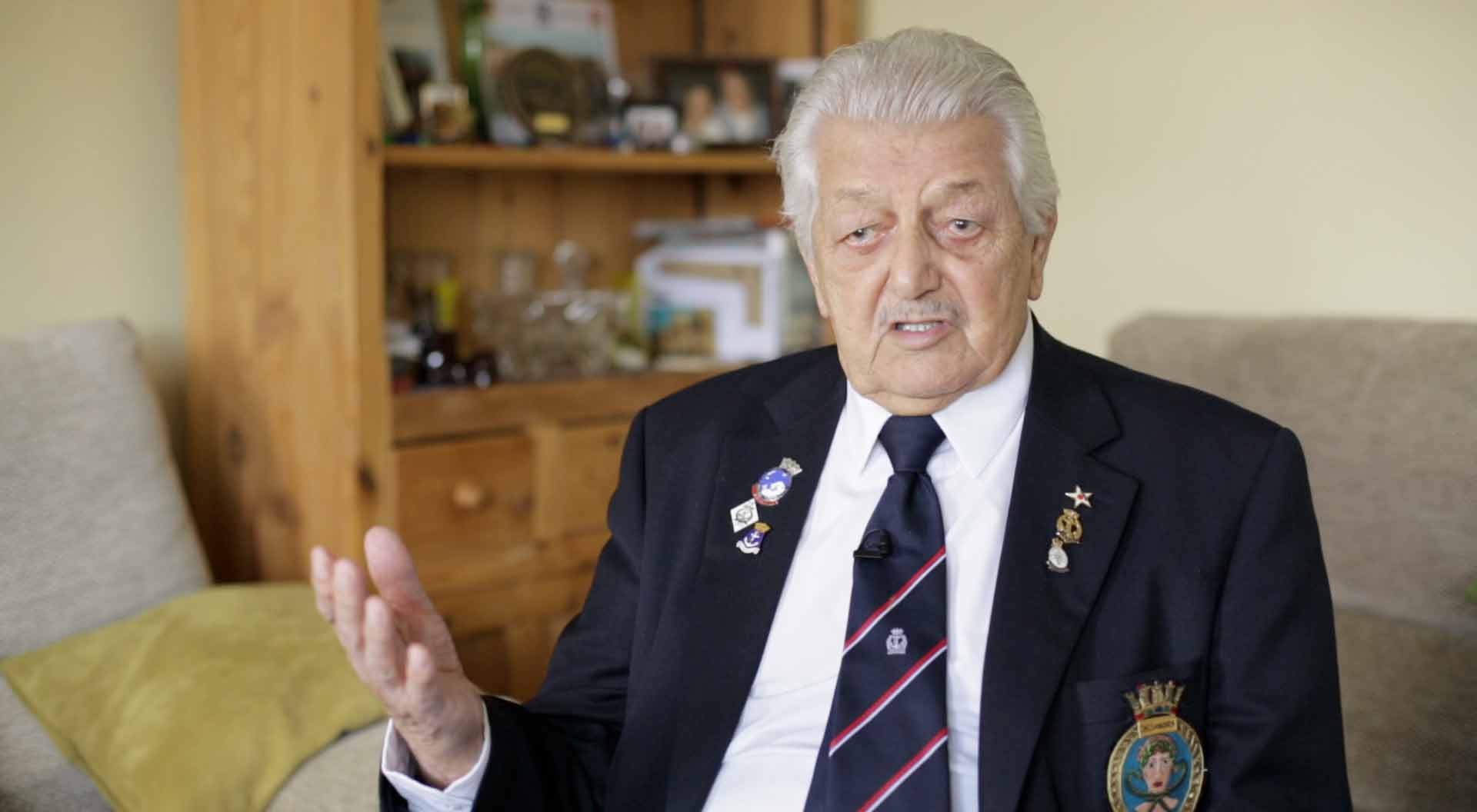
A veteran interview with

Gordon Mellor

Gordon Mellor was an RAF Evader. He was flying in a Halifax bomber when attacked by an ME10 and was forced to bail from his burning plane. 5 of the 8 crew survived.
Play video
Watch the interview

About Gordon Mellor

Gordon Mellor was the Navigator in a Lancaster Bomber shot down over Belgium.  He survived and was fortunate to meet members of the Comète Line, who secreted him to Belgium, France and eventually over the Pyrénées and into Spain. He recently discovered that not only had his group been infiltrated by the Germans, but one of his RAF travelling companions was the cousin of Lord Haw Haw. He passed away in January 2018.

Please note that not all of Gordon’s interview is currently online. Contact us if you would like to see more.

Credits

Interviewed by:
Martyn Cox
Reviewed by:
Natasha Norris

Transcripts:
Please note that transcripts and closed captions in the video player are automatically generated by Vimeo.

Copyright:
All video content, web site design, graphics, images (including submitted content), text, the selection and arrangement thereof, underlying source code, software and all other material on this Web site are the copyright of Legasee Educational Trust, and its affiliates, or their content and technology providers. ALL RIGHTS RESERVED. Any use of materials on this Web site – including reproduction for purposes other than those noted above, modification, distribution, or republication – without the prior written permission of Legasee Educational Trust is strictly prohibited.

Home | Veterans | Gordon Mellor

A veteran interview with

Gordon Mellor

Goirdon-Mellor-Still

Gordon Mellor was an RAF Evader. He was flying in a Halifax bomber when attacked by an ME10 and was forced to bail from his burning plane. 5 of the 8 crew survived.
Related topics & talking points

Keep on watching

More veteran stories...

Share this interview on:

https://www.legasee.org.uk/veteran/gordon-mellor/

Cite this interview:

MLA Style:
Mellor, Gordon. A Veteran Interview with Gordon Mellor. Interview by Martyn Cox. Legasee, n.d. https://www.legasee.org.uk/veteran/gordon-mellor/. Accessed 18 Nov. 2025.
APA Style:
Mellor, G. (n.d.). A Veteran Interview with Gordon Mellor [Interview by Martyn Cox]. Legasee. Retrieved November 18, 2025, from https://www.legasee.org.uk/veteran/gordon-mellor/
Chicago Style:
Mellor, Gordon. n.d.. A Veteran Interview with Gordon Mellor. Interview by Martyn Cox. Legasee. Accessed November 18, 2025. https://www.legasee.org.uk/veteran/gordon-mellor/
Harvard Style:
Mellor, G. (n.d.). A Veteran Interview with Gordon Mellor. [Interviewed by Martyn Cox]. Legasee. Available at https://www.legasee.org.uk/veteran/gordon-mellor/ (Accessed: 18 November 2025)
Vancouver Style:
Mellor, G. A Veteran Interview with Gordon Mellor [Internet]. Interview by M. Cox. Legasee; n.d. [cited 2025 Nov 18]. Available from: https://www.legasee.org.uk/veteran/gordon-mellor/
An interview with

George Duffee

Stranded and separated from his crew, RAF Pilot George Duffee travelled a war-ridden Europe, managing to escape enemy territory during World War II.

George Duffee shares his extraordinary journey, serving as a young RAF pilot during World War II. Growing up in East London during the Blitz, he joined the RAF at the age of seventeen and a quarter. After his training, he was sent to an RAF station in Yorkshire where he was assigned to an air crew who were participating in the bombing of Germany. It was here, so early in his service, he witnessed his life flashing before his eyes when his plane was shot down by enemy forces above Holland. He describes feeling a strange sense of calm as the plane plummeted towards the ground, believing that it was already over for him. However, he managed to escape and reach the ground safely before it finally crashed. The next thing he knew, he was all alone in an unfamiliar environment, not knowing if his crew had survived. He would learn much later that he was the only survivor who did not become a POW. This marked the beginning of a long journey, crossing from border to border to escape enemy territory back into the safety of the British Military. After evading German patrols in Holland, he passed into Belgium where he met members of the Comet Line (a resistance organisation) who would be responsible for successfully helping over 700 Allied Airmen by escorting them away from Belgium and France into Spain where the British were occupied. After arriving in Paris, he exercised in preparation for his climb across the Pyrenees mountains into Spain, later taking a ship to Gibraltar where he finally felt a sense of freedom from the enemy. Along his journey, he met many interesting people of different professions or ranks who were willing to help him. This included a Dutch schoolmaster who he would later refer to as his Dutch brother, a French artist who offered him false papers to get through to Paris and a Gendarme who he initially thought was a potential foe but when George was forced to reveal his identity, he was no longer seen as a threat. However, his constant evasion from German patrols caused an inner battle with his morale as it became more compelling to surrender himself and become a POW, yet he managed to always fight back and regain control of himself. Some time later, after returning to England, he resumed his career as a pilot. He worked as a skipper, participating in 39 bombing missions, even after already being shot down and facing a near death experience so early in his military career. He also contributed to the Berlin Airlift, flying 236 flights in a Lancaster over Berlin while supplying food to the German people who were plagued by famine. George's journey is a fascinating example of the bravery, resilience and luck that is required to be an RAF pilot in WWII, especially when things don't go according to plan.
Service:
Interviewed by:
Martyn Cox
An interview with

Jack Lyon


Jack Lyon: RAF Navigator, POW, and Near-Escapee of the Great Escape

Jack Lyon was commissioned into the Royal Air Force in 1941 and served as a navigator and bomb aimer on Whitley bombers. On only his third operational mission, a failing engine and intense enemy fire forced his crew to bail out over Germany. Captured and treated with surprising civility, Jack became a prisoner of war. He was later interned at Stalag Luft III, where he became involved in the planning of the infamous "Great Escape." Drawn 79th in the lottery of escapees, he narrowly missed getting out when the operation was cut short after 76 had exited the tunnel. Jack later reflected that this near miss may have saved his life, as many escapees were executed by the Gestapo. Throughout his incarceration, he remained remarkably reflective, sharing stories of camaraderie, survival, and unexpected compassion—even from enemy soldiers. His interview is a testament to resilience, duty, and the enduring human spirit.
Service:
Interviewed by:
Martin Bisiker
An interview with

Ken Weaden

An RAF Navigator recalls his involvement in the Berlin Airlift, and what it was like to fly 290 return trips to Gatow Airbase.

Before his involvement in the Berlin Airlift, Ken Weaden grew up in the small village of Easton-in-Gordano in Somerset, where he witnessed the devastating aftermath of the Bristol Blitz. As part of the RAF, Ken went first to Manchester, then to Canada to complete his training, before taking on the position of Navigator during the war, in which he helped with the transport of supplies across Europe. After being demobbed, Ken struggled to adjust to the monotonous routine of his old job and soon returned to the RAF. In this interview, he recalls being stationed in Wunstorf, Germany, then Lübeck, dealing with the fast-paced nature of the job and the frequent flights to Gatow, where new aircrafts would arrive every two minutes. Due to the shift system used, one downside of the role was its noticeable lack of downtime. On his only proper night out, Ken remembers being invited to a dance at a hospital club in Hamburg, which was surprisingly full of English medics.  In total, Ken spent 11 months on the Airlift. Despite the workload, he retains humorous anecdotes from his time in service, like one occasion shortly after the war when his crew were forced to land in a Japanese airfield, and attempted their first meal using chopsticks, with little success. Looking back at his work, Ken considers it a job well done, and affirms that the crews did what they were supposed to do. After two extra years in the RAF, he decided it was the right time to leave.
Service:
Interviewed by:
Martin Bisiker