Home | Veterans | Betty Dobson
Bethie-Dobson

A veteran interview with

Betty Dobson

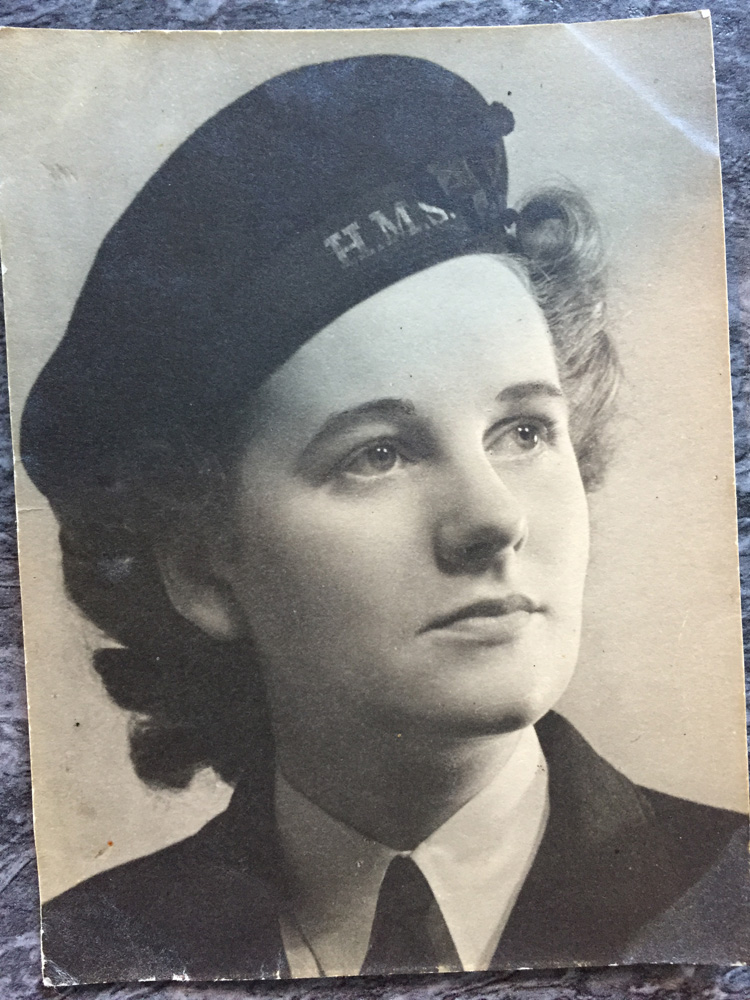
Betty Dobson provides some wonderful colour to her interview which details her life as a Leading Wren in Donibristle, Scotland.

Play video
Watch the interview
Discover 4 key interview topics and talking points

About Betty Dobson

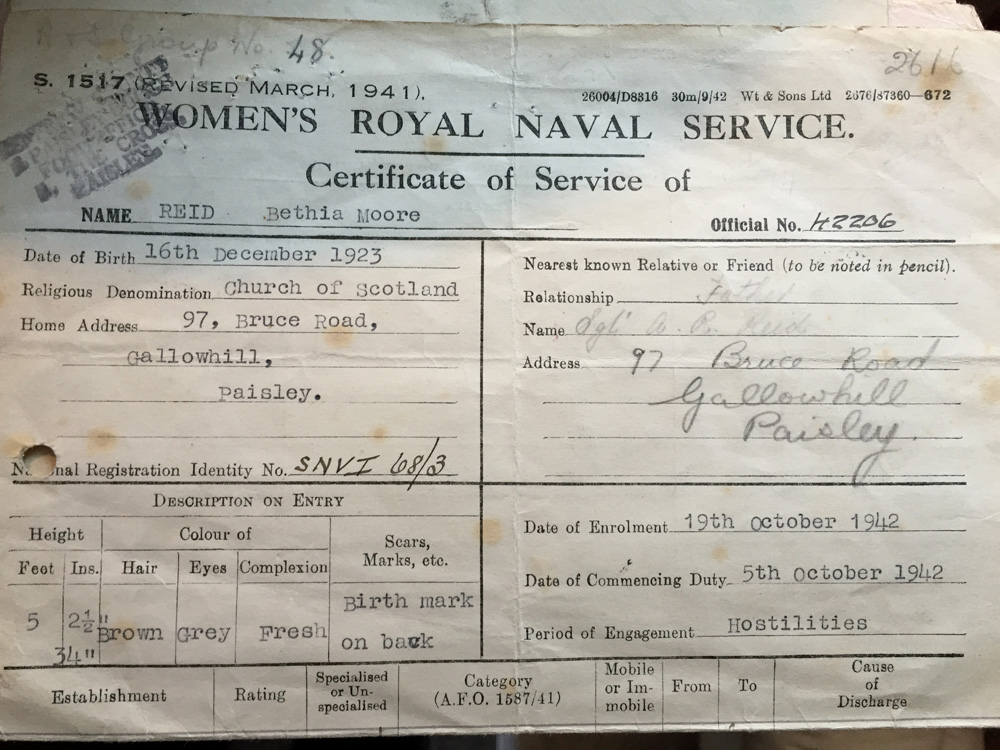
Betty “Bet” Dobson grew up in Scotland and was just a teenager when war broke out. With her father called up in 1939, she was determined to do her part. Though he forbade her from joining the Army, she applied elsewhere and was accepted into the Women’s Royal Naval Service (WRNS).

In her interview, Betty recalls her training in Dunfermline, the pride of putting on her uniform for the first time, and the strict rules about hair and dress. Posted first to Rosyth and then to Donibristle Fleet Air Arm Station, she worked as a teleprinter operator, sending coded signals, weather reports, and urgent supply requests. She describes the relentless noise of the machines, the discipline of secrecy, and the constant rhythm of wartime communications.

Her service later took her to Largs and finally to the Admiralty in London, where she worked underground alongside the WAAF on vast teleprinter switchboards. She shares memories of Christmas pantomimes, strict food rationing, the loss of cousins in the RAF and Army, and the euphoria of VE Day celebrations.

Betty’s story offers a vivid glimpse into the essential but often unseen contribution of the Wrens during the Second World War.

Credits

Interviewed by:
Martin Bisiker
Reviewed by:
Lucy Smith

Transcripts:
Please note that transcripts and closed captions in the video player are automatically generated by Vimeo.

Copyright:
All video content, web site design, graphics, images (including submitted content), text, the selection and arrangement thereof, underlying source code, software and all other material on this Web site are the copyright of Legasee Educational Trust, and its affiliates, or their content and technology providers. ALL RIGHTS RESERVED. Any use of materials on this Web site – including reproduction for purposes other than those noted above, modification, distribution, or republication – without the prior written permission of Legasee Educational Trust is strictly prohibited.

Home | Veterans | Betty Dobson

A veteran interview with

Betty Dobson

Bethie-Dobson

Betty Dobson provides some wonderful colour to her interview which details her life as a Leading Wren in Donibristle, Scotland.

Related topics & talking points

Veteran gallery

Photos & memories

Keep on watching

More veteran stories...

Share this interview on:

https://www.legasee.org.uk/veteran/bethie-dodson/

Cite this interview:

MLA Style:
Dobson, Betty. A Veteran Interview with Betty Dobson. Interview by Martin Bisiker. Legasee, 1 Feb. 2015 https://www.legasee.org.uk/veteran/bethie-dodson/. Accessed 10 Nov. 2025.
APA Style:
Dobson, B. (2015, February 1). A Veteran Interview with Betty Dobson [Interview by Martin Bisiker]. Legasee. Retrieved November 10, 2025, from https://www.legasee.org.uk/veteran/bethie-dodson/
Chicago Style:
Dobson, Betty. 2015. A Veteran Interview with Betty Dobson. Interview by Martin Bisiker. Legasee, February 1. Accessed November 10, 2025. https://www.legasee.org.uk/veteran/bethie-dodson/
Harvard Style:
Dobson, B. (2015). A Veteran Interview with Betty Dobson. [Interviewed by Martin Bisiker]. Legasee, 1 February. Available at https://www.legasee.org.uk/veteran/bethie-dodson/ (Accessed: 10 November 2025)
Vancouver Style:
Dobson, B. A Veteran Interview with Betty Dobson [Internet]. Interview by M. Bisiker. Legasee; 2015 Feb 1 [cited 2025 Nov 10]. Available from: https://www.legasee.org.uk/veteran/bethie-dodson/
An interview with

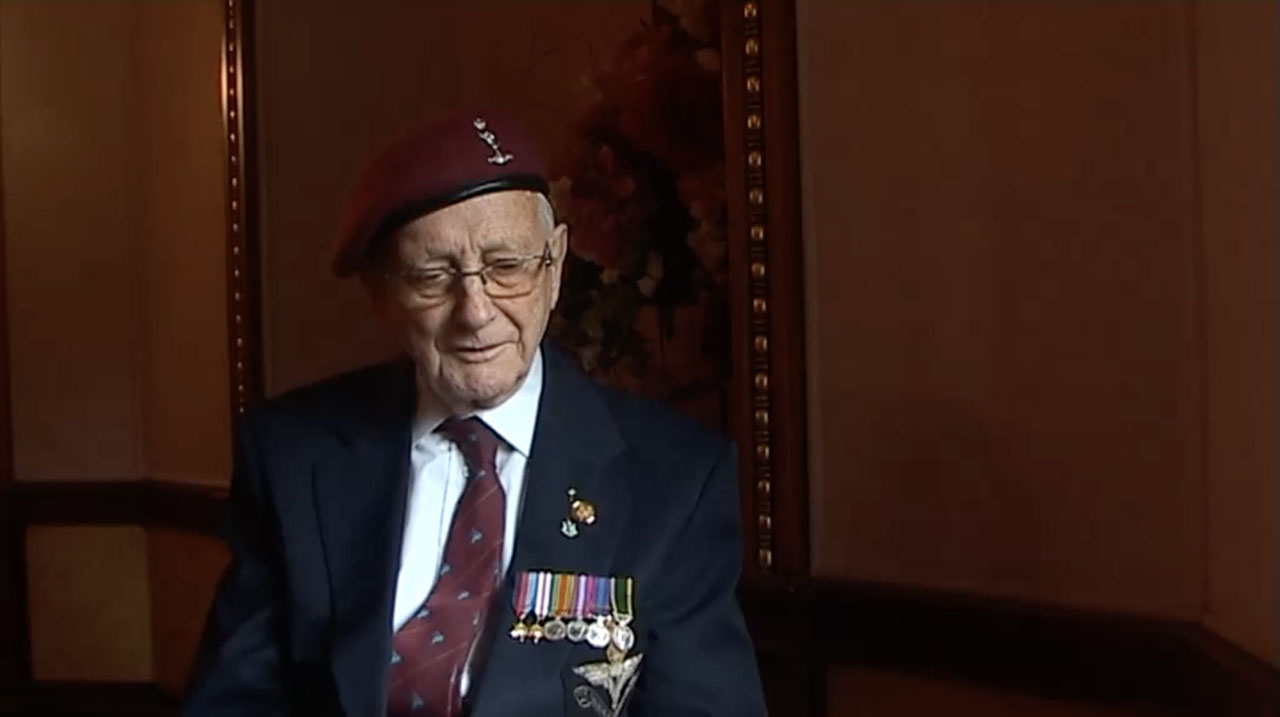
Frank Bewley

Frank Bewley was a Naval aircraft engineer who volunteered to serve in Korea aboard HMS Glory, a light fleet carrier operating for ground support.

Frank Bewley, born in London in 1931, joined the Royal Navy as a volunteer in 1948 and was initially posted to RNAS Culdrose, where he recalls early trials of jets landing without undercarriage. He volunteered for Korea and joined 821 Squadron, which trained at RAF Makrihanish before heading to Korea in 1952. He served on HMS Glory, which flew old World War II Firefly 5s for ground support. He was responsible for maintaining his assigned aircraft and had a close relationship with his pilot, Lieutenant Barrett. Initially unfamiliar with Korea, he learned about its history through old World War II books. He found HMS Glory more friendly than other ships, but prone to rolling. He describes the challenges of working on the flight deck, where a lot of maintenance and arming work was completed, in inclement weather and the camaraderie among the crew. They still operated on messdecks containing up to 14 men, sleeping in hammocks and collecting food form the galley, rather than having a central canteen.
Photo Gallery icon 3 Photos
Service:
Interviewed by:
Martin Bisiker
Antoinette Porter in photo
An interview with

Antoinette Porter

Operation Outward: Balloons, Danger, and D-Day

Antoinette “Tony” Porter joined the Women’s Royal Naval Service as a teenager and quickly found herself in one of the war’s more unusual roles. Selected to take part in Operation Outward, she and her fellow Wrens launched hydrogen balloons fitted with incendiary devices, designed to drift into Germany and cause disruption. The work was heavy, physical, and dangerous. Antoinette recalls the sheer effort of handling the balloons, the types of explosives used, and the burns and injuries some Wrens suffered.

Her interview goes beyond secrecy and danger. Antoinette paints a vivid picture of wartime Britain: the terrifying sight of V1 flying bombs overhead, the exhilaration of watching waves of Allied aircraft depart on D-Day, and the euphoric celebrations of VE Day.

Her memories also reflect on life after the war, as she considers the costs of more recent conflicts. Antoinette’s story brings humour, candour, and humanity to a hidden corner of the Wrens’ wartime service.

Service:
Interviewed by:
Martin Bisiker
An interview with

Fred Roberts

A Royal Marine mentioned in dispatches during the Korean War remembers the raids, injuries and camaraderie of “The Forgotten War”

After joining the Royal Marines and completing his training, Fred travelled to Korea and conducted coastal raids to protect explosives experts from harm. While accompanying a convoy along the Chosin Reservoir, Fred was shot through the foot by North Korean fire. After recovering, he rejoined his unit during an ice-cold winter, which left him unaffected by the cold for decades since nothing compared to the Korean winter. Fred describes his camaraderie with American marines, who he advised against their trigger-happy tendencies because enemy fighters could advance unhindered upon hearing the empty magazine's distinctive “click”. Fred never discovered why he was mentioned in dispatches but wonders if it was for performing his duties while injured. He gave blood from his arm to an injured comrade before their evacuation to a military hospital. He later cared for hospitalised patients, cracking jokes and brewing tea. He becomes emotional remembering those who died in his arms. After returning to Britain, Fred was deemed unfit for service – a decision that still irks him today. He explains that the Korean War, its veterans and the fallen are widely overlooked. Fred’s moving story highlights the need to commemorate those who fought in history’s “Forgotten War”.
Service: