Home | Veterans | Alan Carcary
Alan-Carcary

A veteran interview with

Alan Carcary

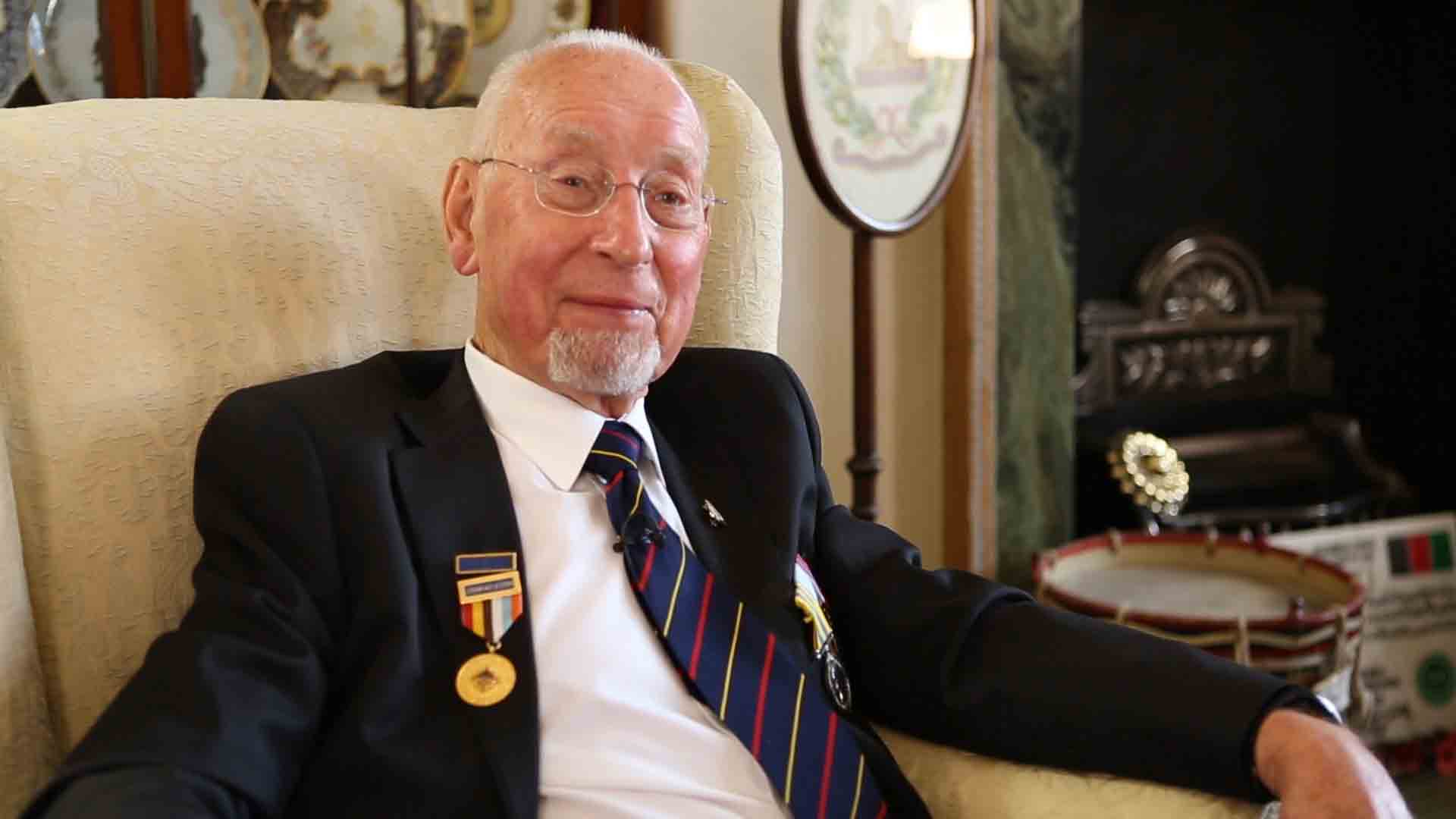
Alan Carcary has an ‘amazing’ story: a boy immersed in music who became a member of the Royal Scots Dragoon Guards

Play video
Watch the interview

About Alan Carcary

Alan reflects on his extensive career as a euphonium player in the military band, which began at age 16 when he auditioned for the army band, driven by his lifelong love of music. He fondly recalls his time at Kneller Hall, which he describes as the historic home of military music and his experiences performing for the community on numerous occasions. In 1972, his band’s single of Amazing Grace became number one in the charts, and they were invited to tour Australia. Alan also toured extensively across America and Europe, including a visit to St. Petersburg in Rome, where his band was invited to breakfast with Pope John Paul II and performed for President Reagan at the White House. In 1977, a particularly busy year, the band played at numerous royal engagements, including at Buckingham Palace, where Alan met the Queen. He recounts his deployment to the Gulf in 1990, where he served as a medic, treating many casualties and the band kept the soldiers’ spirits high by organising a Christmas concert. Alan highlights the emotional challenges band members faced during and after the Gulf War, particularly with limited support.

Credits

Interviewed by:
Martin Bisiker
Reviewed by:
Kitty Wright

Transcripts:
Please note that transcripts and closed captions in the video player are automatically generated by Vimeo.

Copyright:
All video content, web site design, graphics, images (including submitted content), text, the selection and arrangement thereof, underlying source code, software and all other material on this Web site are the copyright of Legasee Educational Trust, and its affiliates, or their content and technology providers. ALL RIGHTS RESERVED. Any use of materials on this Web site – including reproduction for purposes other than those noted above, modification, distribution, or republication – without the prior written permission of Legasee Educational Trust is strictly prohibited.

Home | Veterans | Alan Carcary

A veteran interview with

Alan Carcary

Alan-Carcary

Alan Carcary has an ‘amazing’ story: a boy immersed in music who became a member of the Royal Scots Dragoon Guards

Related topics & talking points

Keep on watching

More veteran stories...

Share this interview on:

https://www.legasee.org.uk/veteran/alan-carcary/

Cite this interview:

MLA Style:
Carcary, Alan. A Veteran Interview with Alan Carcary. Interview by Martin Bisiker. Legasee, n.d. https://www.legasee.org.uk/veteran/alan-carcary/. Accessed 21 May. 2026.
APA Style:
Carcary, A. (n.d.). A Veteran Interview with Alan Carcary [Interview by Martin Bisiker]. Legasee. Retrieved May 21, 2026, from https://www.legasee.org.uk/veteran/alan-carcary/
Chicago Style:
Carcary, Alan. n.d.. A Veteran Interview with Alan Carcary. Interview by Martin Bisiker. Legasee. Accessed May 21, 2026. https://www.legasee.org.uk/veteran/alan-carcary/
Harvard Style:
Carcary, A. (n.d.). A Veteran Interview with Alan Carcary. [Interviewed by Martin Bisiker]. Legasee. Available at https://www.legasee.org.uk/veteran/alan-carcary/ (Accessed: 21 May 2026)
Vancouver Style:
Carcary, A. A Veteran Interview with Alan Carcary [Internet]. Interview by M. Bisiker. Legasee; n.d. [cited 2026 May 21]. Available from: https://www.legasee.org.uk/veteran/alan-carcary/
An interview with

Peter Ford

Serving in the Royal Army Service Corps, Peter tells of his time in Korea as a driver and the difficult conditions they encountered.

Following completion of an apprenticeship, Peter signed on as a regular in the Army for three years in 1951, because it meant he could choose where he wanted to serve. After training, he served in the Royal Army Service Corps as a driver. He tells of a posting to HQ Southern Command and from there being sent to Korea. Like many others, he explains that he hadn’t heard of Korea before this. Embarking at Southampton on the Empire Fowey, he and his compatriots travelled first to Japan. He recounts the journey from Japan to Korea, travelling through Hiroshima and seeing the crater, following which he was parachuted into Seoul. He was posted to the 26th Field Ambulance Division and drove both ambulances and transport. He tells of the poor conditions of the roads and the impact of the weather on their work, including that their trucks would freeze during the winter if not looked after properly. At the end of the Korean War, Peter tells of his brief foray into athletics, running for the battalion. He was then posted to Hong Kong. He expresses frustration at the lack of attention given to the Korean war in comparison to other wars.
Service:
Interviewed by:
Martin Bisiker
An interview with

Gilbert Beck

Gilbert Beck: A Veteran’s Voice in Music

Gilbert Beck’s journey into military music began humbly in rural Oxfordshire, where his father brought home a grand piano from a local market, sparking a lifelong passion. Raised in a musical family, Gilbert sang in the church choir and played organ before joining the Army in 1948 as a band boy with the Royal Artillery. Trained at Woolwich and later Kneller Hall, Gilbert played double bass, tuba, and bass trombone, eventually joining the North Staffordshire Regiment. His musical service took him across Europe and into the Korean War, where he played a vital role in maintaining morale. From conducting services with a portable organ to performing for multinational troops, including Canadians and Americans, his music helped bridge cultural divides in a devastated landscape. In Korea, Gilbert played at the dedication of a tented village for displaced civilians and led hymns at makeshift services in Gloucester Valley. His experience highlighted the humanising power of music amid the harshness of war. Later selected for the demanding bandmaster course at Kneller Hall, Gilbert's talent earned him great respect, even as he ultimately chose family life over a full military career. Music remained central to Gilbert’s life, both in and out of uniform - a true servant of harmony in service and in peace.
Photo Gallery icon 44 Photos
Service:
An interview with

Rex Sheppard

From a parochial fisherman to the front line in Korea, Rex recounts his transformative experience of National Service

Rex shares his transformative experience of national service, going from a 'Jack the lad' fisherman in Ipswich, to Section Commander in Korea, all for a boy of 18 who had never left his home ground.

Rex describes traveling on The Windrush from Southampton to 'The Territories', 3 miles from Hiroshima to complete increasingly arduous military training run by Colonel Lonsdale designed to transform the men into “killing machines”.

From here the men were ½ a mile away from the Chinese military camps, where they could, on a clear day, see their enemy training to fight against them.

As soon as he turned 19, Rex was sent to Uijeongbu, to be quickly immersed in front line duty. He was soon to become a section commander, responsible for running patrols in the challenging landscape of paddy fields and mountains, at times coming within 150 yards of the North Korean and Chinese front line.

Rex recounts his experiences of living with Siberian winds, psychological warfare, 'Hill 335' and the brutality and carnage of fighting on 'The Hook', where death was only a whistle away. His story is one of resilience and comradeship.

Service:
Interviewed by:
Martin Bisiker